
NBA Expert Bets: Data-Driven Picks and Strategies for UK Bettors
Where Data Meets the Hardwood.
 Available in US
Three years ago, I placed what I thought was a sure thing — a Lakers spread bet based purely on their star power. Lost by half a point. That single loss taught me more about NBA expert bets than the previous five years combined: this game rewards methodology, not gut feelings.
The numbers behind professional basketball wagering are staggering. Americans placed approximately $42.7 billion in legal bets on NBA and professional basketball in 2025 alone. Meanwhile, the UK betting market generates £16.8 billion in Gross Gambling Yield annually, with basketball carving out an increasingly significant slice of that figure. These aren't casual hobby figures — this represents a sophisticated global market where information asymmetry creates genuine opportunities.
After nine years specialising in spread analysis and value identification for UK bettors, I've developed a framework that cuts through the noise. The approach isn't about picking winners based on team loyalty or media narratives. It's about identifying where bookmaker lines misprice probability, understanding how schedule factors create exploitable edges, and maintaining the discipline to capitalise on those opportunities consistently.
What separates profitable NBA betting from recreational punting comes down to three pillars: rigorous data analysis, proper bankroll management, and an understanding of how UK bookmakers price basketball markets differently from their American counterparts. Most British bettors approach NBA games with the same mindset they'd apply to Premier League football — and that's precisely where the market inefficiencies emerge.
This guide consolidates everything I've learned about finding value in NBA markets. We'll cover the mechanics of spread betting, the methodology behind expert picks, how to read Against The Spread records meaningfully, and why the UK market offers specific advantages that savvy bettors can exploit. Whether you're transitioning from football betting or looking to sharpen an existing basketball approach, the principles here apply across experience levels.
The Data-Driven Edge in 90 Seconds
- NBA betting generated $42.7 billion in US handle during 2025 — this liquidity creates efficient markets where finding edges requires systematic analysis, not gut feelings.
- Point spread betting dominates because it equalises mismatched teams at near-even odds; the Oklahoma City Thunder's 68% cover rate in 2024-25 shows elite ATS performance remains achievable.
- UK bettors face unique advantages: decimal odds simplify calculations, regulated bookmakers provide consumer protections, and late-night tip-offs filter out casual action.
- Value betting means identifying when your probability assessment exceeds implied odds — at 1.91 decimal odds, you need 52.4% accuracy just to break even.
- Bankroll management separates sustainable approaches from gambling: flat staking at 1-3% per bet, line shopping across multiple bookmakers, and honest record-keeping enable long-term participation.
Understanding NBA Betting Markets
My first NBA bet was a moneyline wager on the Miami Heat in 2017. I didn't even know what a point spread was. Looking back, that ignorance probably cost me hundreds of pounds in missed value over the following months. Understanding the fundamental market types isn't just helpful — it's the entry fee for serious basketball betting.
Basketball accounts for 32% of the US sports betting market, making it the most popular sport for wagering in America. That liquidity creates deep, efficient markets where lines move quickly on sharp money. For UK bettors, this means NBA odds often reflect more sophisticated pricing than many domestic alternatives.

Point Spread (ATS) — The margin of victory a favourite must win by, or an underdog must stay within, for the bet to succeed. A team listed at -6.5 must win by 7 or more points to "cover" the spread.
The spread market dominates NBA betting for good reason. When the Golden State Warriors face the Charlotte Hornets, a straight moneyline bet on Golden State might offer decimal odds around 1.15 — risking significant capital for minimal return. The spread equalises the contest, typically setting both sides near 1.91 odds in decimal format.
Moneyline — A straight bet on which team wins the game, regardless of margin. No spread involved, though odds reflect the perceived probability difference between teams.
Home teams in the NBA win approximately 60% of games outright, which translates to roughly a 3-point advantage built into spread calculations. This figure has remained remarkably consistent over the past decade, though individual venue advantages vary significantly. Understanding this baseline helps identify when bookmakers overprice or underprice home court advantage for specific matchups.
UK bookmakers display all NBA odds in decimal format by default. A spread line showing -4.5 with odds of 1.91 means you're risking £1 to profit £0.91 if your selection covers. American odds (-110) and decimal odds (1.91) represent the same probability — the format differs, but the maths remains identical.
Totals betting — the over/under on combined points — offers a third major market. Here, you're wagering on pace and defensive efficiency rather than which team wins. A matchup between two high-tempo offences might see totals set at 235.5 points, while a defensive slugfest could sit at 208.5.
Over/Under (Totals) — A wager on whether the combined final score of both teams will exceed or fall below the bookmaker's posted number.
Each market type serves different analytical approaches. Spread betting rewards understanding of relative team strength and situational factors. Moneylines favour identifying outright upset potential. Totals demand pace analysis and defensive matchup evaluation. Most successful NBA bettors specialise in one or two markets rather than spreading attention across all three.
How Expert Picks Are Made
I spent the entire 2019-20 season tracking every variable I could think of — rest days, travel distance, referee assignments, even humidity levels in arenas. Most of it was noise. But buried in that mountain of data were three factors that consistently predicted spread outcomes better than public perception: back-to-back scheduling, closing line movement, and pace differential. That year taught me that expert analysis isn't about more data — it's about the right data.
Andrew Wilsher, managing editor at Pickswise, captured it well: making accurate, reasoned NBA predictions requires hours of analysis, research, and number crunching — and that's just for one prediction. The casual bettor who spends five minutes checking injury reports is competing against professionals who've spent five hours modelling that same game.
The gap between recreational and professional handicapping isn't intelligence — it's time investment. Sharp bettors aren't necessarily smarter; they're more systematic about identifying where public perception diverges from mathematical probability.
AI-driven prediction models have transformed the landscape. OddsTrader's 5-star picks claim an average accuracy of 73.43% — a figure that would generate substantial long-term profit if consistently achievable. Whether these models maintain edge as markets adapt remains debatable, but they've certainly raised the bar for what "expert analysis" means in 2026.
My methodology synthesises four primary inputs. First, injury reports — but not just the headline absences. Role player availability often matters more to spread outcomes than star player status, which bookmakers typically price efficiently. Second, schedule context: travel distance, time zone changes, and days of rest. Third, pace and efficiency metrics that project how a specific matchup will play out stylistically. Fourth, line movement analysis that reveals where sharp money has landed before tipoff.
73.4%
Claimed accuracy rate of 5-star AI model picks
3+ Hours
Time professional handicappers invest per game analysis
4 Inputs
Core data categories: injuries, schedule, pace metrics, line movement
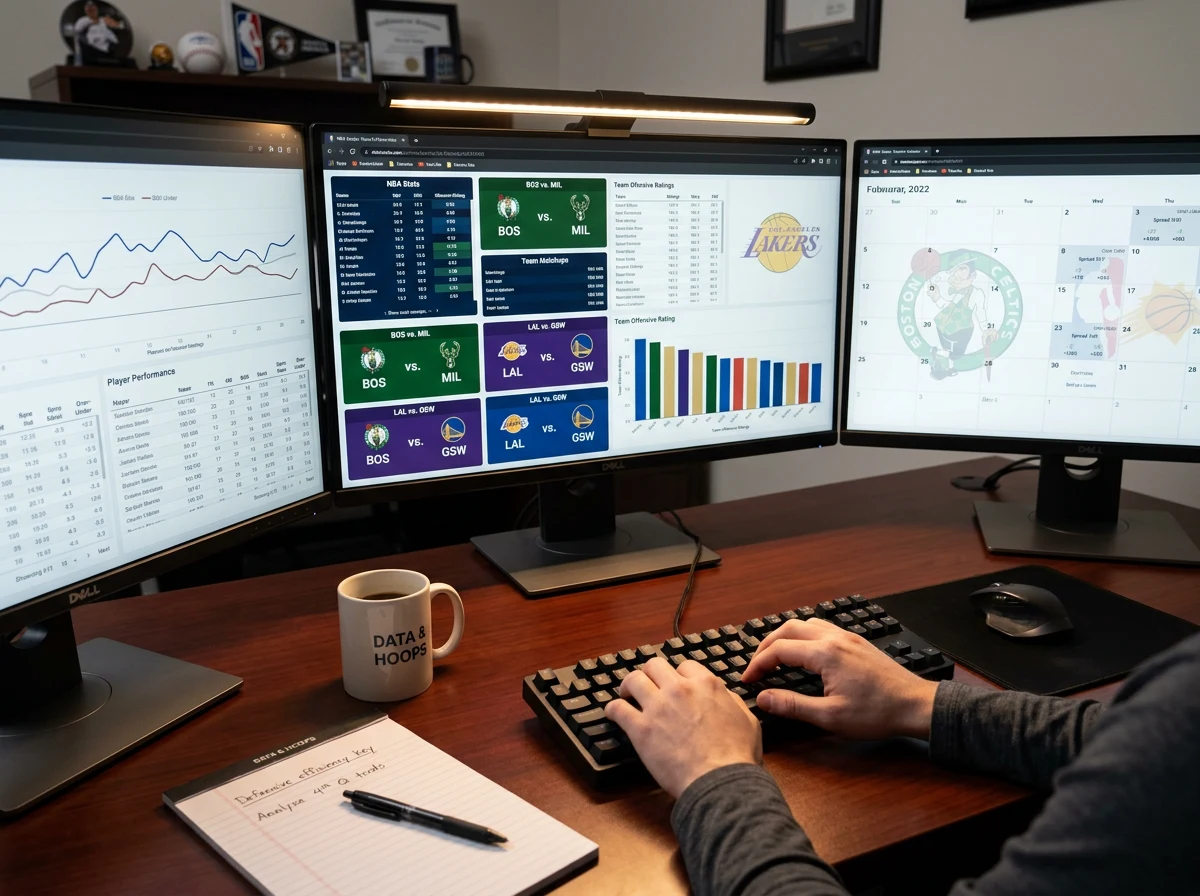
The process isn't glamorous. Most mornings during the season, I'm checking injury designations by 7am, cross-referencing with overnight line movements, and building a shortlist of games where my projections diverge from market prices by more than 2%. Some days that yields three potential plays. Some days it yields zero. The discipline to pass on marginal edges separates sustainable approaches from recreational gambling.
For a deeper dive into the mechanics of spread analysis, the complete NBA spread betting guide breaks down line reading, movement interpretation, and strategic approaches specific to UK bettors.
UK Bookmakers for NBA Betting
When I started betting NBA from the UK in 2015, finding decent basketball lines meant creating accounts with four different bookmakers and checking each one before every wager. That morning ritual hasn't changed — but the market depth has improved dramatically. Approximately 10% of the UK population now participates in online sports betting, with 290 million online bets placed monthly on real events. That volume has pushed British bookmakers to take NBA coverage seriously.
The regulatory environment here differs fundamentally from the American market. UK Gambling Commission licensing provides consumer protections that many offshore alternatives lack, though it comes with restrictions too. The Remote Gaming Duty increases to 40% from April 2026, which may affect how aggressively bookmakers price certain markets. Understanding this landscape helps explain why UK NBA odds sometimes differ from what American sharp bettors see.
| Feature | Major UK Bookmakers | US-Facing Sportsbooks |
|---|---|---|
| Odds Format Default | Decimal | American |
| Market Depth (NBA) | Comprehensive spreads, totals, props | Deeper player prop variety |
| Live Betting Hours | Often late-night UK time | Prime time coverage |
| Responsible Gambling Tools | Mandatory UKGC requirements | Varies by state |
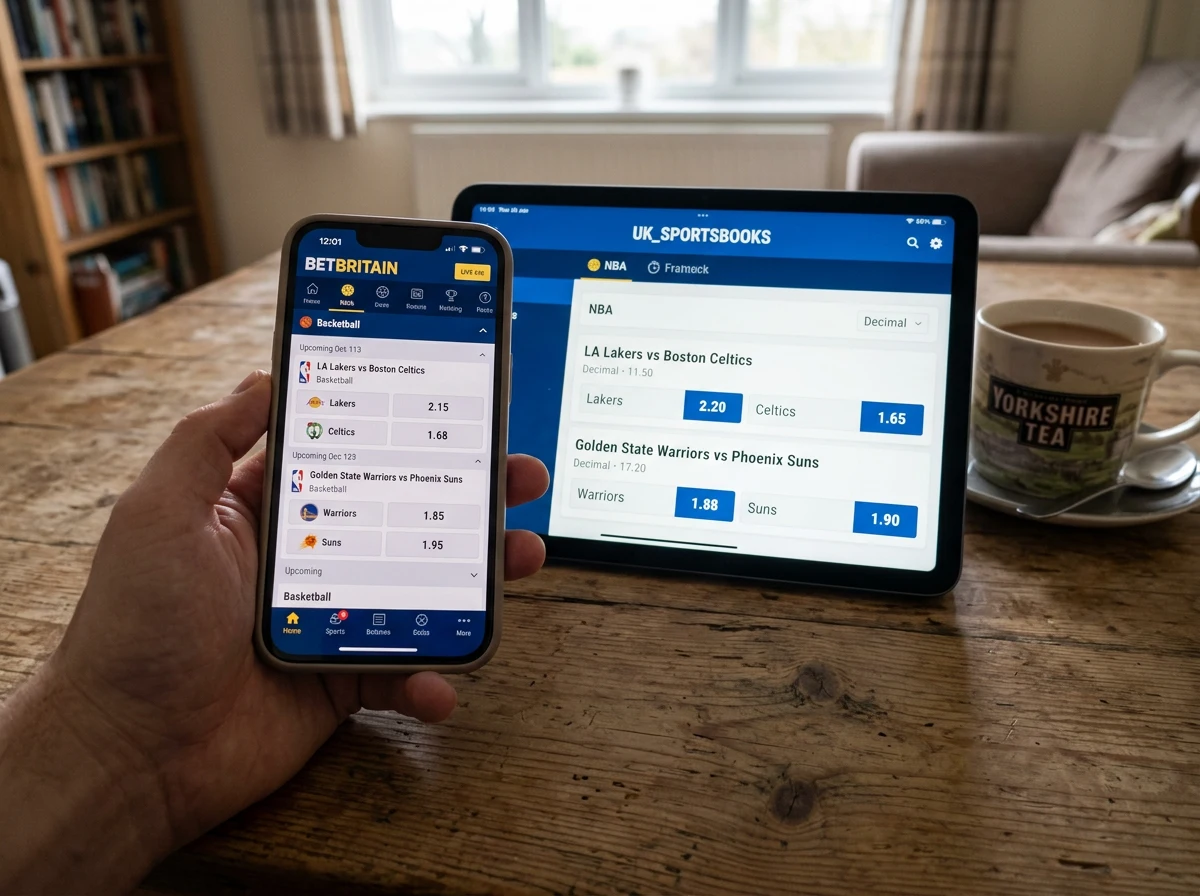
Line shopping across multiple UK books remains essential. I've seen spread differentials of a full point on the same game between major operators — the difference between a push and a loss on more occasions than I can count.
Example: Celtics vs Bucks — Spread Market
Celtics -4.5, odds 1.91
Celtics -4.0, odds 1.87
Celtics -4.5, odds 1.95
Same game, three different UK bookmakers, three different lines. If you fancy Boston, the middle option offers a half-point better spread at slightly reduced juice. That half-point won't matter most nights — but over hundreds of wagers, it compounds significantly. The slightly lower odds (1.87 vs 1.91) might be worth accepting for the better number, depending on your assessment of closing line value.
NBA games typically tip off between 11pm and 3am UK time, which creates practical considerations. Live betting opportunities exist but require either night owl tendencies or careful pre-game positioning. Most UK bookmakers offer full pre-game NBA markets from mid-morning, giving ample time for analysis before American sports news cycles add late volatility.
The detailed UK bookmaker comparison for NBA explores specific platform strengths, from exchange options to prop market depth and cash-out functionality.
Spread Betting Fundamentals
The first time I saw "OKC -6.5" on a betting slip, I thought it meant Oklahoma City needed to score exactly 6.5 more points than their opponent. Embarrassing in hindsight, but that confusion is more common than experienced bettors admit. Point spread betting forms the backbone of NBA wagering, yet its mechanics remain opaque to many entering the market.
A point spread represents the bookmaker's projected margin of victory. When the Thunder are listed at -6.5 against the Jazz, they're expected to win by roughly 7 points. Backing Oklahoma City requires them to win by 7 or more — the "cover." Taking Utah +6.5 means they can lose by up to 6 points and you still profit. The half-point eliminates push scenarios where the margin lands exactly on the number.
Decimal odds of 1.91 on either side of a spread represents roughly 4.5% juice (bookmaker margin). This means you need to win approximately 52.4% of spread bets at these odds just to break even — a threshold that sounds achievable but proves challenging over large sample sizes.
The Oklahoma City Thunder posted the best ATS record of the 2024-25 season at 53-25-4, covering 68% of their spreads. That kind of sustained performance is exceptional. Most teams hover between 45-55% cover rates, which explains why identifying even small edges matters so much over time.
Cover Rate — The percentage of games in which a team beats the point spread. A 68% cover rate like OKC's 2024-25 season represents historically elite spread performance.
UK bookmakers display spreads in decimal format, which simplifies payout calculation. A £100 bet at 1.91 odds returns £191 total (£91 profit) if successful. American odds show the same information differently — -110 means risking £110 to win £100 — but the underlying maths remains identical.
What trips up many newcomers is the relationship between spread size and probability. A -2.5 favourite in a close matchup isn't twice as likely to cover as a -5 favourite in a mismatch. Line sizes reflect expected margins, not confidence levels. Understanding this distinction prevents the common mistake of assuming larger spreads represent "safer" positions.
Value Betting Principles
I lost money for my entire first season betting NBA. Not because I picked the wrong teams — my win rate was actually decent at 53% — but because I consistently bet on games where the odds didn't justify the risk. The lesson came hard: winning bets and finding value are completely different skills.
Tony George, a professional handicapper with decades of experience, summarises the mentality shift required: "We are betting numbers, not teams." That statement sounds obvious, yet it contradicts how most recreational bettors approach NBA wagering. They bet on the Lakers because they believe in the Lakers, not because the line offers mathematical value.
Value exists when your assessed probability of an outcome exceeds the implied probability of the odds offered. If you believe a team has a 55% chance to cover, and the odds imply only 50%, you've found value — regardless of whether that specific bet wins or loses.
The editorial team at BettingNBA.co.uk distils this into three words: discipline, research, and value hunting are key for long-term success. Notice the order — discipline comes first. Finding value means nothing if you can't execute consistently, pass on marginal edges, and avoid tilting after losses.
Calculating expected value requires two inputs: your probability assessment and the odds offered. If you estimate Boston has a 56% chance to cover -3.5 and the decimal odds are 1.91, the expected value calculation runs: (0.56 × 0.91) - (0.44 × 1) = 0.51 - 0.44 = +0.07. That positive EV of 7% suggests a bet worth making, assuming your probability estimate is accurate.
Nevada sportsbooks recorded a basketball win rate of 5.88% in 2025 — meaning the house kept roughly 6 cents of every dollar wagered. That narrow margin shows how little separates winning and losing at scale.
The challenge lies in accurately assessing probability. This is where the hours of analysis pay off — or don't. If your 56% estimate is actually closer to 51%, that "positive EV" bet becomes negative. Self-honesty about analytical limitations matters as much as the analysis itself.
For detailed methodology on expected value calculation and odds comparison across UK platforms, the value bets identification guide provides step-by-step frameworks applicable to any NBA market.
Bankroll Management Overview
During the 2021 playoffs, I had my best analytical month ever — correctly called 14 of 18 spread picks. I also nearly blew up my bankroll. The problem wasn't the losing bets; it was the winning ones. Success made me reckless, increasing stake sizes beyond any reasonable system. By June, my unit size had tripled without any corresponding edge improvement. That run taught me that bankroll discipline matters most precisely when you're winning.
The unit system provides structure against emotional decision-making. A "unit" represents a fixed percentage of your total bankroll — typically 1-3% — that remains consistent regardless of confidence level or recent results. If your bankroll stands at £2,000, a 2% unit equals £40 per bet. Whether the previous ten bets all won or all lost, that figure stays constant.
Nevada sportsbooks handled approximately $2.46 billion in basketball wagers during 2025 in that state alone. The collective betting public lost around 6% of that figure to the house. Beating this margin consistently requires not just finding edges, but sizing bets appropriately to survive inevitable losing stretches.
Pre-Bet Checklist
- Is this bet within my standard unit size (1-3% of bankroll)?
- Have I checked injury reports from the last 24 hours?
- Have I compared odds across at least three UK bookmakers?
- Am I betting based on analysis, not to recover recent losses?
- Would I make this same bet tomorrow with fresh eyes?
Variance in NBA betting runs longer than most bettors expect. A 55% winning bettor — which represents genuine, profitable skill — can easily experience 15-game losing streaks due to random distribution. Without proper stake sizing, those streaks destroy bankrolls before the edge has time to manifest.
The complete bankroll management guide covers unit sizing methods, the Kelly Criterion debate, drawdown management, and scaling strategies as your bankroll grows or contracts. These aren't advanced concepts for professional bettors — they're foundational requirements for anyone wagering more than pocket change.
ATS Records Analysis
A friend messaged me halfway through the 2024-25 season asking why I kept betting against the Cleveland Cavaliers despite their league-best win record. The answer was simple: straight-up records and ATS records tell entirely different stories. Cleveland was winning games but failing to cover inflated spreads. The public saw dominance; I saw market overpricing.
Against The Spread records measure how often a team beats the point spread, not how often they win games outright. This distinction separates analytical bettors from recreational ones. A team can go 60-22 straight up while posting a losing ATS record if bookmakers consistently set their lines too high.
53-25-4
Oklahoma City Thunder ATS record 2024-25 — best in the league
68%
Cover rate representing historically elite spread performance
The Thunder's 2024-25 campaign illustrates why ATS data matters. Their 68% cover rate wasn't luck — it reflected a young, improving team whose point differential consistently exceeded market expectations. Identifying these situations early in a season provides months of exploitable edges before lines adjust.
The Charlotte Hornets entered the 2025-26 season with the league's best ATS record through November — despite sitting near the bottom of the standings. Low expectations created beatable spreads.
Reading ATS data requires context. A 10-game ATS streak means little statistically; sample size is too small. Season-long trends carry more weight but still require situational breakdown. Home versus away splits, performance as favourite versus underdog, and results in specific schedule situations all provide layers beneath the headline number.
The trap most bettors fall into is chasing recent ATS trends without understanding why they occurred. If a team covered five straight as underdogs, was it because they're genuinely undervalued — or because they faced a particularly weak stretch of opponents? Raw ATS numbers without context lead to false confidence.
For detailed frameworks on interpreting ATS data, identifying sustainable trends versus statistical noise, and applying these records to game selection, the ATS records interpretation guide provides comprehensive methodology.
The Edge Audit
A 68% cover rate over one season and a 70% cover rate over ten games are not the same claim. Enter an ATS record and this tool separates the part that is skill from the part that is luck — then shows what the surviving edge actually does to a bankroll.
Pushes are returned, so they are excluded from the cover rate.
1.91 is standard spread pricing, and needs 52.4% to break even.
This sets how much evidence a record needs before the tool believes it.
Enter a record and run the audit.
The shaded curve is every cover rate a coin-flip bettor would post over this many bets. Inside it, your record is indistinguishable from luck.
Flat staking, priced at your odds, with the edge sampled from the range still consistent with your record — not from the flattering headline number.
Method
Signal Score is the probability that the true long-run cover rate behind a record clears the break-even rate implied by your odds. The record is combined with a prior belief centred on 50% — the rate a spread is designed to produce — whose strength you set with the market question. A record that would take hundreds of bets to prove cannot score highly on eighty.
True edge estimate is the posterior mean: the observed rate pulled toward 50% by an amount that depends on sample size. Eighty bets move it a little; two thousand move it a lot. Luck alone does this reports how often a 50% bettor matches or beats the observed rate over the same number of bets.
Survival runs 1,500 simulated futures. Each future draws its own true cover rate from what your record still allows, then plays out your chosen number of bets at a flat stake. Ribbons show the middle 50% and middle 90% of outcomes; ruin means the bankroll can no longer cover one stake.
Estimates from your inputs, not predictions. Past ATS performance does not fix future results. 18+ · BeGambleAware.org
Player Props Introduction
I ignored player props for my first three years of NBA betting. Spreads and totals felt like the "real" markets — props seemed like novelty bets for casual fans who wanted action on their favourite players. That dismissal cost me significantly. The sharpest edge I've ever had in basketball betting came from a player assists market that moved 30 minutes before tipoff while the spread barely budged.
Player proposition bets isolate individual performance: points scored, rebounds grabbed, assists distributed, three-pointers made. Unlike team-level markets where information gets priced in rapidly, player props often reflect stale projections that don't account for recent rotation changes, matchup specifics, or rest patterns.
PropStarz, a CBS Sports analyst specialising in NBA player markets, compiled a documented record of 490-353 on NBA prop bets over two seasons, generating +75.73 units of profit. That sustained edge demonstrates props can support serious wagering strategies — not just recreational side action.
The market dynamics differ from spreads in important ways. Bookmaker limits on player props tend to be lower, which constrains how much sharp money can be placed. This creates slower line movement and longer-lasting inefficiencies. A £500 limit might seem restrictive, but for most bettors it's more than sufficient — and the softer lines compensate for sizing constraints.
Effective props betting requires granular research: usage rates when specific teammates are absent, historical performance against certain defensive schemes, pace-adjusted projections for individual matchups. It's more time-intensive per bet than spread analysis, but the potential edges are often larger.
UK bookmakers have expanded their NBA props coverage substantially since 2023. Points, rebounds, and assists markets are now standard; three-pointers, blocks, and steals appear for most games; combination props (points + rebounds + assists) offer additional angles. The depth varies by operator, making multi-account line shopping particularly valuable in this segment.
Schedule Factors
November 2023: the Denver Nuggets, defending champions, travelled from a home game against Sacramento to Miami for a back-to-back. They were 3.5-point favourites. I bet Miami +3.5 without hesitation — not because the Heat were better, but because Denver was playing their fourth game in six nights across three time zones. They lost outright. Schedule analysis isn't about predicting upsets; it's about identifying when the market underprices fatigue.
Back-to-back games remain the most exploitable schedule factor in NBA betting. Teams playing the second night of consecutive games face measurable performance decline: reduced shooting efficiency, slower defensive rotations, and higher fourth-quarter collapse rates. Bookmakers account for this, but often insufficiently, particularly early in the season before rest patterns establish clear baselines.
Approximately 19% of NBA games are decided in the fourth quarter, according to analysis of 2,295 matches. Schedule-fatigued teams disproportionately falter in these late-game situations — a factor that compounds the back-to-back disadvantage beyond headline statistics.
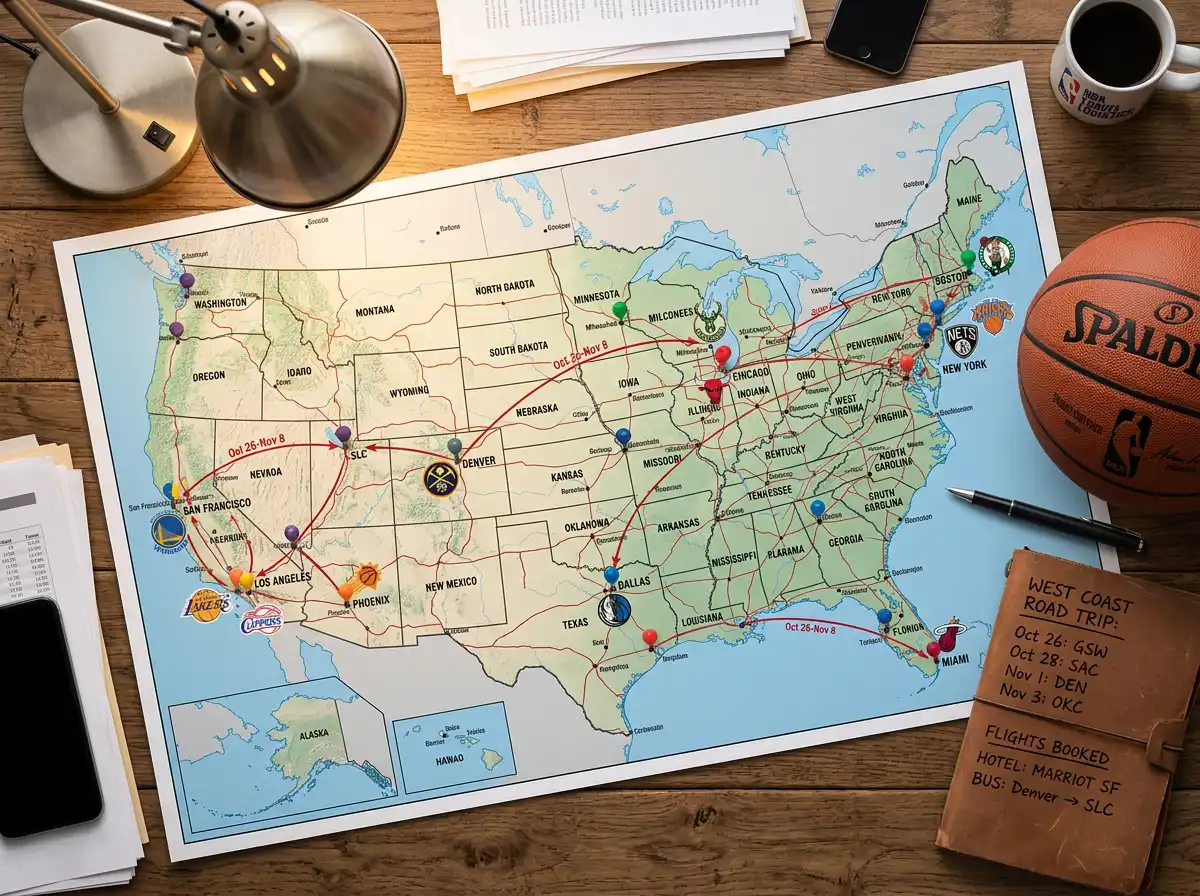
Rest advantage works similarly in reverse. A team with three or more days off faces the "rest versus rust" dilemma — fresh legs but disrupted rhythm. Historical data suggests rest advantage peaks at two days off; beyond that, the benefits plateau and can actually reverse for teams that rely heavily on game-to-game momentum.
Travel distance adds another layer. West Coast teams travelling east for early-afternoon starts (which feel like morning games to their body clocks) underperform against the spread consistently. The NBA's 82-game schedule creates dozens of these situations annually — each one a potential edge for bettors who track logistics carefully.
I maintain a simple spreadsheet tracking rest days, travel miles, and time zone changes for every team before making spread selections. It's tedious work that most bettors skip. That's precisely why the edges persist. Markets price obvious factors efficiently; they price tedious factors less so.
The interplay between schedule factors and home court advantage creates particularly interesting scenarios. A rested road team facing a back-to-back home team might neutralise or even reverse the typical home edge — situations where understanding baseline assumptions helps identify mispriced lines.
Integrity and Sharp Money
When the Jontay Porter scandal broke in 2024, my immediate reaction wasn't surprise — it was concern about how the league would respond to betting markets. The NBA has embraced gambling partnerships worth hundreds of millions, but that relationship requires maintaining credibility. Understanding the integrity monitoring framework helps contextualise why certain line movements matter more than others.
Public perception data is sobering. Approximately 33% of Americans believe that NBA players and coaches are "often or sometimes" involved in illegal actions to influence betting outcomes. Whether accurate or not, that scepticism reflects real concern. A larger figure — 64% of Americans — believes the rise of legal sports betting has increased the frequency of improper conduct by athletes and officials.
Anindya Sen, the NBA's Senior Director of Basketball Strategy and Integrity, explained their monitoring approach: "That data is very granular. We're still trying to figure out how to use it in our integrity analyses." The league tracks betting patterns across regulated markets, looking for anomalies that precede unusual game outcomes. What triggers investigation? Sen's guidance is instructive: "There should be a basketball reason that explains the line move."
Sharp money — bets from professional syndicates and respected winning players — moves lines before public money arrives. When a line shifts from -4 to -5 without any news catalyst, sharp action is typically responsible. Following these moves can be informative but requires understanding why the sharp money landed there, not just that it did.
The distinction between sharp and public money matters for handicapping purposes. Public betting tends to favour favourites, home teams, and franchises with national media coverage. Sharp money often takes the other side of these biases — not because contrarianism itself wins, but because public perception creates mispriced lines.
UK bettors face an information disadvantage here. American sportsbooks publish betting percentages showing ticket counts and money splits; most UK bookmakers don't. Services that aggregate this data charge subscription fees, which may or may not justify their cost depending on your wagering volume. I've found that tracking line movement timing — watching when lines change relative to game start — provides similar intelligence without additional expense.
Brittani Webb, an assistant professor at Quinnipiac University, summarised the tension: even with recent gambling scandals looming over the NBA season, most fans feel fairly confident they're watching fair games — but those feelings waver as they recognise that legalised sports betting has opened the door to questionable tactics. Navigating this requires neither naivety nor paranoia, but awareness of how integrity concerns can create market inefficiencies in either direction.
Responsible Gambling
I've had friends who started betting NBA with me who no longer bet at all — not because they lost interest, but because they recognised patterns in their own behaviour that concerned them. One told me he was waking up at 3am to watch games he'd bet on, unable to sleep, refreshing his bookmaker app compulsively. That conversation changed how I think about discussing betting strategy. Technical edge means nothing if it destroys other parts of your life.
The UK regulatory framework provides protections that many bettors don't fully utilise. Every licensed bookmaker must offer deposit limits, loss limits, session time reminders, and self-exclusion options. These tools exist because the industry recognises — and regulators mandate — that some participants will develop problematic patterns.

Research indicates in-play bettors demonstrate higher rates of problem gambling than those who place only pre-game wagers. The rapid pace of live betting creates decision environments that can amplify impulsive behaviour, particularly during late-night NBA viewing when judgement may already be compromised by fatigue.
The profile of someone likely to develop sports betting problems cuts across demographics: typically male, under 35, employed, often with higher education. In other words, exactly the demographic most likely to approach NBA betting analytically. Intelligence and financial sophistication don't protect against behavioural patterns that can become compulsive.
Approximately 95% of online gambling in the UK occurs from home, according to Gambling Commission data. That accessibility — the ability to place bets without leaving your couch, at any hour — represents both convenience and risk. The friction that once existed in betting (traveling to a shop, counting cash) has disappeared. For some people, that friction served a protective function.
If you find yourself betting more than you planned, chasing losses with increased stakes, lying to others about your gambling activity, or experiencing distress when unable to bet, these are warning signs worth taking seriously. BeGambleAware offers free support at begambleaware.org, and GamStop allows UK residents to self-exclude from all licensed online gambling sites simultaneously. Using these resources isn't weakness — it's the same analytical discipline applied to personal wellbeing instead of betting lines.
Frequently Asked Questions About NBA Expert Betting
How do NBA point spreads work?
Point spreads create a handicap that levels the playing field between unevenly matched teams. When Boston is listed at -6.5 against Charlotte, they must win by 7 or more points for a bet on Boston to succeed. Conversely, a bet on Charlotte +6.5 wins if the Hornets lose by 6 or fewer points, or win outright. The half-point eliminates ties, ensuring every bet resolves as a win or loss. UK bookmakers display spreads in decimal odds format — typically around 1.91 on either side, implying approximately equal probability after the handicap adjustment.
What is the best NBA betting strategy for beginners?
Start with spread betting on a small number of games rather than seeking action on every night of the schedule. Focus your analysis on two or three factors you can track consistently — injury reports, back-to-back situations, and closing line movement provide accessible entry points. Use flat staking at 1-2% of your bankroll per bet, resist the urge to increase stakes after wins or chase losses with larger bets. Keep records of every wager including your reasoning, then review monthly to identify where your analysis succeeds and fails. Building analytical discipline matters more than finding a "system" that promises guaranteed profits.
How accurate are NBA expert picks?
Legitimate expert picks from documented sources typically achieve accuracy rates between 53-58% on spread bets over meaningful sample sizes. AI-driven models claim figures like 73% on their highest-confidence selections, though these claims require scrutiny regarding sample size and selection criteria. Any service claiming 65%+ accuracy across all picks over hundreds of wagers should be viewed sceptically — such results would generate returns that exceed what even professional syndicates achieve. Track records matter more than claimed accuracy; insist on independently verifiable results before trusting any paid pick service.
What factors should I consider when betting on NBA games?
The primary factors worth tracking include injury reports (both star players and key rotation pieces), schedule context (back-to-backs, travel distance, rest days), pace matchups (how competing offensive and defensive tempos interact), and line movement (where early money has pushed the spread). Secondary considerations include historical ATS performance in similar situations, referee assignment tendencies, and home court advantage variability by venue. Weighting these factors appropriately requires experience — avoid assigning equal importance to every variable, and be honest about which factors you can analyse competently versus which you're guessing on.
Is it possible to make consistent profit from NBA betting?
Yes, but the bar for consistency sits higher than most expect. Sportsbooks maintain approximately 5-6% hold on NBA betting, meaning the collective betting public loses that percentage over time. Beating this edge requires winning roughly 52.4% of spread bets at standard -110 odds, sustained over hundreds of wagers. Professional bettors exist who achieve this, but they represent a small minority. For most people, realistic goals involve breaking even while enjoying the entertainment value, or generating small supplemental returns that don't justify quitting a day job. Entering with expectations of "making a living" typically leads to disappointment and poor decision-making.
What are the most common NBA betting mistakes?
Overconfidence after winning streaks leads bettors to increase stake sizes beyond their system, exposing them to catastrophic losses when variance corrects. Betting too many games dilutes analytical focus — most successful bettors wager on fewer than 10% of available games. Ignoring line shopping across multiple bookmakers leaves value on the table unnecessarily. Chasing losses with larger bets to "get even" compounds bad variance with poor decision-making. Treating team loyalty as analysis causes bettors to overvalue familiar franchises. Finally, neglecting record-keeping prevents learning from mistakes, causing the same errors to repeat indefinitely.
How do UK bookmakers compare for NBA betting?
Major UK bookmakers offer comprehensive NBA spread, moneyline, and totals markets with competitive pricing. Differences emerge in prop market depth (some offer extensive player props while others provide only core markets), live betting functionality (interface quality and market availability during games), and promotional structures. Line accuracy varies by operator, making multi-account registration valuable for identifying which books consistently offer the best numbers on specific market types. The Betfair Exchange provides an alternative structure where bettors set their own lines, though NBA liquidity on exchanges runs lower than major football markets. Ultimately, maintaining accounts with three or four operators enables effective line shopping without administrative burden.
Applying Expert NBA Betting Principles
Nine years into this journey, my approach looks nothing like where I started. The Lakers fan who once bet with his heart now spends mornings tracking injury designations, schedule patterns, and line movements before coffee. The transformation wasn't instant — it came from hundreds of losing bets that forced honest evaluation of what was working and what wasn't.
The UK market offers specific advantages for NBA bettors willing to exploit them. Bookmakers here price basketball as a secondary sport, creating inefficiencies that don't exist in football markets. The regulatory framework provides consumer protections and responsible gambling tools that enable sustainable participation. Late-night tip-off times filter out casual action, leaving lines that can be beaten with proper preparation.
Profitable NBA betting combines systematic analysis (spread mechanics, ATS interpretation, value identification), disciplined execution (bankroll management, line shopping, record-keeping), and honest self-assessment (recognising limitations, avoiding emotional decisions, maintaining sustainable practices). Technical knowledge alone accomplishes nothing without the behavioural framework to apply it consistently.
Start smaller than you think necessary. Track everything. Be sceptical of your own confidence. The same analytical rigour that identifies underpriced lines should apply to evaluating your own performance — including the uncomfortable moments when data shows your edge isn't as large as you believed.
Whether you're transitioning from Premier League betting or building an NBA approach from scratch, the principles in this guide provide a foundation. The edges exist. Finding them requires work that most bettors won't do. That asymmetry — between effort required and effort typically invested — is precisely why patient, methodical approaches still pay.
Articles
Prepared by the nbaexpertbets.com editorial staff.
